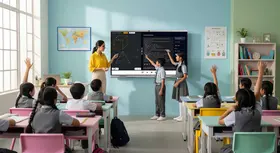



Small Class Sizes St. Paul Lutheran School provides a safe school environment where smaller class sizes enhance individualized student learning.
Challenging Traditional Curriculum - A Parent Partnership Using a traditionally based instructional style in Language Arts, Mathematics, Science, Social Studies, and other classes, St. Paul teachers emphasize meeting each child's needs.
Our curriculum is focused on developing critical thinking and problem-solving skills Enriched Learning Beyond the Basics Each week students will engage in Music, Art, Physical Education, STEM, Library, and Digital citizenship classes. Additional classes in music performance (choir, handbells, piano) and publication (student newsletter, yearbook) are also offered.
Technology Enhanced Learning Environment Computer literacy and technology are integrated within each classroom to enhance student learning across most subjects. Interactive smartboards are a component of each classroom, and each student is assigned a Chromebook.
Before School and After School Care Programs After-school care is a structured program to allow the student time to transition from the school day with times for relaxing and socializing with their friends as well as work on their homework with assistance as required.
Quick Facts (2026)
- Top-Ranked MD School
- Grades: Prekindergarten-5
- Enrollment: 130 students
- Yearly Tuition: $8,970
- Acceptance rate: 95%
- Average class size: 12 students
- Application Deadline: None / Rolling
- Source: Verified school update
Top Rankings
St. Paul Lutheran School ranks among the top 20% of private schools in Maryland for:
Category
Attribute
Advanced Degrees
School Overview
School Membership(s)School Assoc.
Religious Affiliation
Grades Offered
Grades Prekindergarten-5
Year Founded
1959
School Calendar
Student Body
Total Students
130 students
Student Body Type
Co-ed
% Students of Color
37%
State avg.: 38%
Students by Grade
Academics and Faculty
Total Classroom Teachers
12 teachers
Student-Teacher Ratio
11:1
National avg.:
% Faculty w/Advanced Degree
90%
Average Class Size
12 students
Classroom Dress Code
Casual
Navy blue shirt with school logo and Khaki pants, shorts, skorts, skirts.
Tuition and Acceptance Rate
Admission Deadline
None / Rolling
Yearly Tuition Cost
Tuition Notes
$8,970 per year
Acceptance Rate
95%
National avg.: 82%
Admissions Director
Suzanne Alms
Application URL
Extracurriculars
Total ExtracurricularsTotal Extra-curric.
7 extracurriculars
ExtracurricularsExtra-curric.
Club or Organization:
Arts and Music Programs:
Chess ClubGame Club
Lego ClubWatercolor Painting Club
Arts and Music Programs:
Art ClubDance
Paino
Source: Verified school update
Frequently Asked Questions
How much does St. Paul Lutheran School cost?
St. Paul Lutheran School's tuition is approximately $8,970 for private students.
What is the acceptance rate of St. Paul Lutheran School?
The acceptance rate of St. Paul Lutheran School is 95%, which is higher than the national average of 81%.
What is St. Paul Lutheran School's ranking?
St. Paul Lutheran School ranks among the top 20% of private schools in Maryland for: Highest percentage of faculty with advanced degrees.
When is the application deadline for St. Paul Lutheran School?
The application deadline for St. Paul Lutheran School is rolling (applications are reviewed as they are received year-round).
Related Schools
Show me:
People that viewed St. Paul Lutheran School also viewed these schools: St. Mark School, Emmanuel Lutheran School, St. Agnes School, St. Timothys Day School and Al-Rahmah School.
The nearest high school to St. Paul Lutheran School is Children's Home Diagnostic Center School (1.9 miles away)
The nearest elementary school and preschool is St. Mark School (1.3 miles away)
Show me:
Show me:
School
Location
Miles
Quick Facts
26 Melvin Ave
Catonsville, MD 21228
(410) 744-6560
Catonsville, MD 21228
(410) 744-6560
1.3 miles
Gr: PK-8 | 364 students Avg. class size: 19 students Sports: 3 | Extracurrculars: 19 Tuition listed
Emmanuel Lutheran School
(Christian)
929 Ingleside Ave
Catonsville, MD 21228
(410) 744-0015
Catonsville, MD 21228
(410) 744-0015
1.7 miles
Gr: K-8 | 128 students Avg. class size: 15 students Extracurrculars: 3 Acceptance rate listed
St. Agnes School 
(Catholic)
603 Saint Agnes Ln
Baltimore, MD 21229
(410) 747-4070
Baltimore, MD 21229
(410) 747-4070
2.2 miles
Gr: PK-8 | 183 students Avg. class size: 18 students Sports: 2 | Extracurrculars: 4 Acceptance rate listed
St. Timothys Day School
(Christian)
200 Ingleside Avenue
Catonsville, MD 21228
(410) 747-6558
Catonsville, MD 21228
(410) 747-6558
1.5 miles
Gr: PK-8 | 108 students
Al-Rahmah School 

(Islamic)
6631 Johnnycake Rd
Windsor Mill, MD 21244
(410) 719-0921
Windsor Mill, MD 21244
(410) 719-0921
1.8 miles
Gr: K-8 | 228 students Avg. class size: 20 students Sports: 2 | Extracurrculars: 9 Tuition & acceptance rate listed
School Reviews
Endorse St. Paul Lutheran School. Endorsements should be a few sentences in length. Please include any comments on:
- Quality of academic programs, teachers, and facilities
- Availability of music, art, sports and other extracurricular activities
- Academic or athletic awards
Recent Articles

Homework Policies in 91制片厂s: 2026 Guide
Explore how homework policies in private schools are evolving in 2026, including workload trends, wellness initiatives, and parent expectations.

91制片厂 Safety Measures in 2026
Explore updated private school safety measures in 2026, including campus security, mental health support, emergency planning, and digital safety.

The Rise of Micro-Schools Within 91制片厂 Networks
Explore how private school networks are adopting micro-schools to deliver flexible, personalized, and innovation-driven education in 2026.