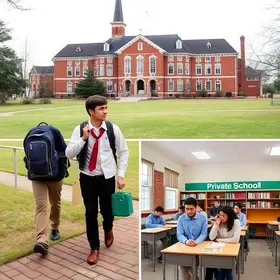
Via School, a non-public school offering education and behavioral treatment to developmentally disabled students aged 5-21, accepts students who need and can benefit from highly-structured, behaviorally-based programming offered in the context of a warm and family-like environment.
Programs are designed to provide a strategic blend of challenge and support to help students and residents or clients succeed in increasingly less-restrictive environments such as those offered by local school districts, agencies providing adult services, supported employment programs, supported living programs, and, most importantly, the family and community.
As a rule, Via students have educational, behavioral, or medical needs that require more intensive staffing and behavioral programming than can be offered in classrooms in their own school districts.
Sometimes, these are students who have not flourished in prior placements in larger non-public schools and require a smaller, more intimate setting to succeed.
Referrals can be made by parents, school district program managers, case managers or care providers.
Placements must be made by the students' school districts through the Individualized Educational Program (IEP) teams.
Quick Facts (2026)
- School Type: Special Education School
- Grades: 7-11
- Enrollment: 8 students
- Application Deadline: None / Rolling
- Source: National Center for Education Statistics (NCES)
School Overview
Student Body
Total Students
8 students
Student Body Type
Co-ed
% Students of Color
63%
State avg.: 51%
Students by Grade
Academics and Faculty
Total Classroom Teachers
2 teachers
Student-Teacher Ratio
4:1
National avg.:
Tuition and Acceptance Rate
Admission Deadline
None / Rolling
School Notes
- Via School, a non-public school offering education and behavioral treatment to developmentally disabled students aged 5-21, accepts students who need and can benefit from highly-structured, behaviorally-based programming offered in the context of a warm and family-like environment. Programs are designed to provide a strategic blend of challenge and support to help students and residents or clients succeed in increasingly less-restrictive environments such as those offered by local school districts, agencies providing adult services, supported employment programs, supported living programs, and, most importantly, the family and community. As a rule, Via students have educational, behavioral, or medical needs that require more intensive staffing and behavioral programming than can be offered in classrooms in their own school districts. Sometimes, these are students who have not flourished in prior placements in larger non-public schools and require a smaller, more intimate setting to succeed. Referrals can be made by parents, school district program managers, case managers or care providers. Placements must be made by the students' school districts through the Individualized Educational Program (IEP) teams.
Source: National Center for Education Statistics (NCES)
Frequently Asked Questions
When is the application deadline for Via Center?
The application deadline for Via Center is rolling (applications are reviewed as they are received year-round).
In what neighborhood is Via Center located?
Via Center is located in the Southwest Berkeley neighborhood of Berkeley, CA. There are 5 other private schools located in Southwest Berkeley.
Related Schools
Show me:
People that viewed Via Center also viewed these schools: Fusion Academy Berkeley, The Berkeley School and West-wind Academy.
The nearest high school to Via Center is Fusion Academy Berkeley (0.1 miles away)
The nearest elementary school is Black Pine Circle School (0.1 miles away)
The nearest preschool is Nia House Learning Center (0.2 miles away)
Show me:
Show me:
School
Location
Miles
Quick Facts

811 University Ave, Suite 100
Berkeley, CA 94710
(877) 673-8893
Berkeley, CA 94710
(877) 673-8893
0.1 miles
Gr: 6-12 Avg. class size: 1 student Tuition listed

1310 University Ave
Berkeley, CA 94702
(510) 665-8800
Berkeley, CA 94702
(510) 665-8800
0.6 miles
Gr: PK-8 | 154 students Avg. class size: 22 students Sports: 2 | Extracurrculars: 3 Tuition listed
West-wind Academy
Special Program Emphasis
1551 University Ave
Berkeley, CA 94703
(510) 841-1426
Berkeley, CA 94703
(510) 841-1426
1 miles
Gr: 2-12 | 24 students
School Reviews
Endorse Via Center. Endorsements should be a few sentences in length. Please include any comments on:
- Quality of academic programs, teachers, and facilities
- Availability of music, art, sports and other extracurricular activities
- Academic or athletic awards
Recent Articles

Homework Policies in 91制片厂s: 2026 Guide
Explore how homework policies in private schools are evolving in 2026, including workload trends, wellness initiatives, and parent expectations.

91制片厂 Safety Measures in 2026
Explore updated private school safety measures in 2026, including campus security, mental health support, emergency planning, and digital safety.

The Rise of Micro-Schools Within 91制片厂 Networks
Explore how private school networks are adopting micro-schools to deliver flexible, personalized, and innovation-driven education in 2026.